The 9 states with no income tax
Nine states take nothing from your salary. Every one of them raises the money somewhere else — and for some households the swap costs money rather than saving it. Put your salary and your house in and see which of the nine actually pays, and the house price at which each one stops.
 Written and edited by Pablo Ruiz QuinteroSources checked September 1, 2026Every figure checked against the authority that sets it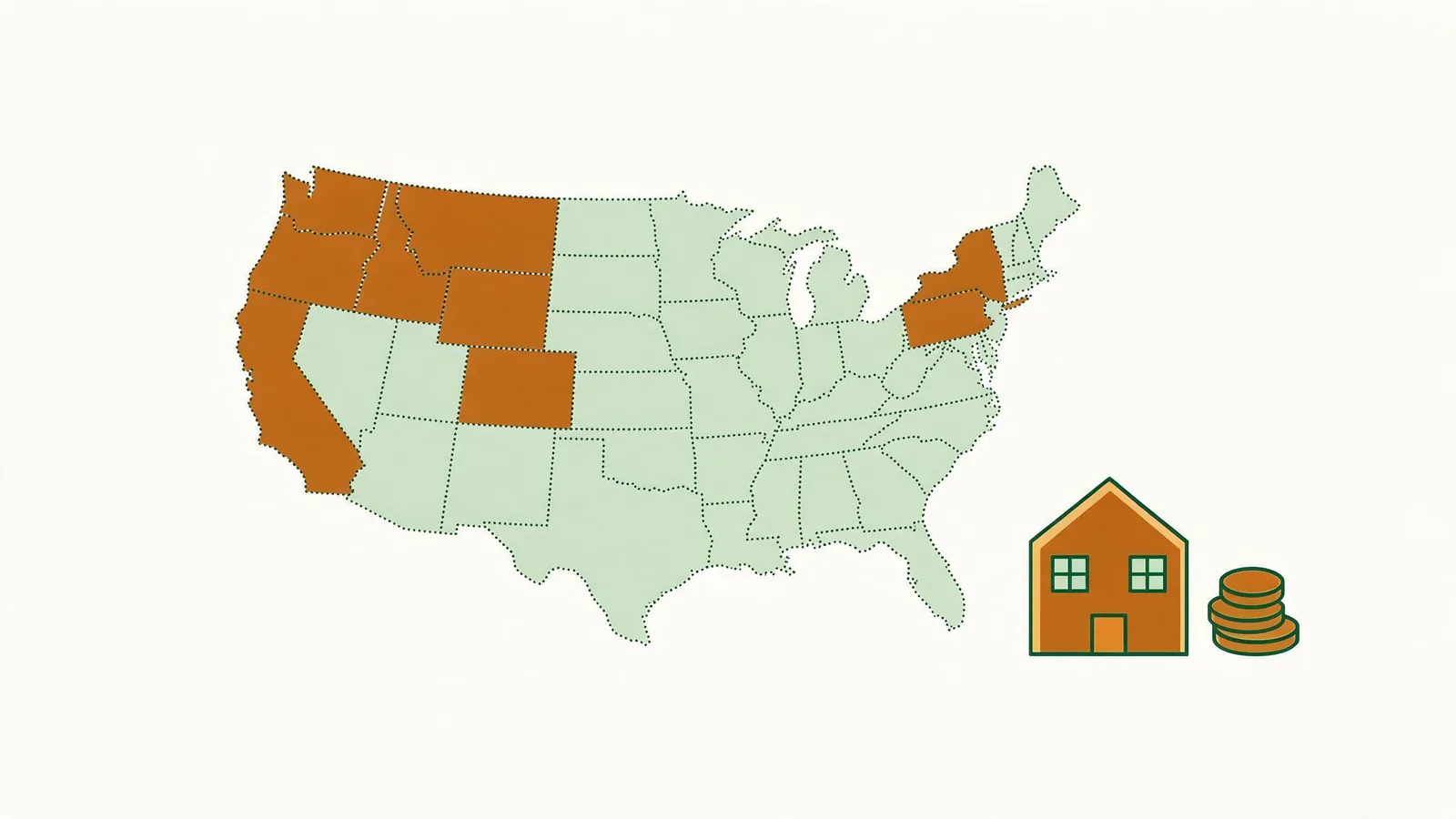
California takes $6,915 of state income tax at this salary and $3,170 of property tax on this home, at its median county rate of 0.70%.
a year, counting the state income tax you stop paying against the property tax you start
| State | Property tax | Net a year | Stops paying above |
|---|---|---|---|
| Tennessee0.50% | $2,264 | $7,821 | any realistic price |
| Nevada0.51% | $2,285 | $7,800 | any realistic price |
| Wyoming0.57% | $2,543 | $7,542 | any realistic price |
| Alaska0.72% | $3,224 | $6,861 | any realistic price |
| Florida0.74% | $3,317 | $6,768 | any realistic price |
| Washington0.79% | $3,538 | $6,547 | any realistic price |
| South Dakota1.08% | $4,848 | $5,237 | $1,854,379 |
| Texas1.25% | $5,630 | $4,456 | $1,265,321 |
| New Hampshire1.98% | $8,910 | $1,175 | $542,096 |
All nine pay at these numbers, but read the last column before deciding: raise the house price and several stop paying. Sales tax is not in any of these figures, because working it out would mean assuming how much you spend.
Which nine, and why they can afford it
Alaska, Florida, Nevada, New Hampshire, South Dakota, Tennessee, Texas, Washington, Wyoming. In several the prohibition sits in the state constitution rather than in ordinary legislation, which makes introducing one a matter of amending it rather than passing a bill.
Each replaces the revenue differently, and the replacement explains a great deal about how living there actually feels. Alaska and Wyoming lean on severance revenue from natural resources. Nevada leans on tourism and gaming. Florida leans on tourism and on property. Texas and New Hampshire lean heavily on property tax.
Where none of those is large enough, property carries the weight — which is why 3 of the 9 we have county data for sit above the national median county rate of 0.84%. That is not a coincidence; it is the arithmetic of having to raise the money somewhere.
Washington is the one partial case left, and it is worth knowing before a move built on investment income: it charges 7% on the sale or exchange of long-term capital assets, under the law its legislature passed in 2021. It applies to individuals only, on gains allocated to Washington, and the department adjusts the standard deduction for inflation each year. New Hampshire used to be the second such case and no longer is — its tax on interest and dividends was repealed for periods beginning after 31 December 2024, which is recent enough that most published lists have not caught up.
On $85,000 single, living in any of the nine saves the entire state layer: up to $5,835 a year compared with the most expensive state, while federal tax of $9,870 and FICA of $6,503 continue exactly as everywhere else.
What each of the nine takes from a house instead
The median county effective property rate in each, computed from Census data on tax actually paid over median home value — which is the only figure comparable across state lines.
Alaska. Median county rate 0.72% — $2,866 a year on a $400,000 home, below the national median of 0.84%. Homestead exemption of $150,000.
Florida. Median county rate 0.74% — $2,948 a year on a $400,000 home, below the national median of 0.84%. It caps growth: 3% on assessed value. Homestead exemption of $51,411.
Nevada. Median county rate 0.51% — $2,031 a year on a $400,000 home, below the national median of 0.84%. It caps growth: 3% on the bill itself.
New Hampshire. Median county rate 1.98% — $7,920 a year on a $400,000 home, above the national median of 0.84%.
South Dakota. Median county rate 1.08% — $4,310 a year on a $400,000 home, above the national median of 0.84%.
Tennessee. Median county rate 0.5% — $2,012 a year on a $400,000 home, below the national median of 0.84%.
Texas. Median county rate 1.25% — $5,004 a year on a $400,000 home, above the national median of 0.84%. It caps growth: 10% on assessed value. Homestead exemption of $140,000.
Washington. Median county rate 0.79% — $3,145 a year on a $400,000 home, below the national median of 0.84%. It caps growth: 1% on what the district may collect.
Wyoming. Median county rate 0.57% — $2,261 a year on a $400,000 home, below the national median of 0.84%. Homestead exemption of $0.
Read the cap line carefully, because three different things are called a cap and they are not equivalent. A cap on assessed value limits the base; a cap on the bill limits what you are charged; a cap on the levy limits only what the district collects in total, and your own bill can rise well beyond it if your property gained value faster than your neighbours'.
Who actually comes out ahead
The swap is not neutral across households, and the direction depends on the ratio between your income and your housing rather than on either alone.
A high earner in modest housing wins clearly. Income tax scales with earnings, property tax follows the house, so someone earning $250,000 and renting or owning modestly avoids a large income tax bill and picks up a small property one. This is the case the headline comparison describes, and it is real.
A modest earner in an expensive house frequently loses. Income tax at that level would have been small — the standard deduction of $16,100 shelters a substantial share of it — while the property bill follows the house regardless. Add sales tax, which falls hardest on households that spend most of what they earn, and the total can exceed what a state with an income tax would have charged.
A retiree is the sharpest case in either direction. Income falls, property tax does not: a bill that was 3% of income while working can be 9% afterwards. Against that, several states with income taxes exempt retirement income generously — so the comparison for a retiree is genuinely different from the one for a worker, and often points the other way.
The arithmetic that settles it is total tax on your actual income plus total tax on your actual housing, in both places. Every state page here gives the first half and all 3,143 county pages give the second.
Seven, eight or nine — and why almost every published list is now out of date
People search for this with a number attached and they use different ones. The count depends on whether you mean wages or any personal income at all, and that distinction decides whether the answer applies to you.
Nine take nothing from a salary. Alaska, Florida, Nevada, New Hampshire, South Dakota, Tennessee, Texas, Washington, Wyoming. If your question is about wages — which it almost always is — nine is the number.
Eight take nothing from any personal income, and this is the figure that has just changed. Only Washington still taxes income that is not a wage: 7% on the sale or exchange of long-term capital assets, since 2022.
Seven was right until the 2024 tax year and is not right now. New Hampshire's Interest and Dividends Tax — the other half of that seven — is gone. The rate was 5% for periods ending before 31 December 2023, 4% for periods ending on or after that date and 3% for periods ending on or after 31 December 2024, and the tax was repealed for taxable periods beginning after 31 December 2024. Its own Department of Revenue Administration says so on the page for the tax.
That is why the internet disagrees with itself here. Most published lists were written while New Hampshire was still winding the tax down in stages, and froze at whatever the number was that year. Checked 2026-09-22 in both states' own documents, the pair is nine and eight.
What none of the counts tells you is the thing that decides the money, which is what each of them charges instead. That is the calculator at the top of this page.
And the two questions people ask next
"Which states have no sales tax?" Two that this site has confirmed in the states' own documents — Alaska and Montana — and three more that are widely reported to charge none and whose own sites refused every request made from here: New Hampshire, Delaware, Oregon. Publishing a zero we have not read would be the same mistake as publishing any other unverified figure, so those three are named rather than counted.
Only Alaska appears on both that list and this page's nine — and Alaskan boroughs levy sales taxes of their own, so "no sales tax" there means no state sales tax rather than none at all. The overlap between giving up income tax and giving up sales tax is almost empty, which is the whole argument of this page in one observation: a state that forgoes one of the three big taxes leans harder on the other two.
"Which states have no property tax?" None. Not one of the fifty. Property tax is overwhelmingly a local tax — counties, municipalities and school districts — and no state has abolished it, because it is what funds schools. Searches for it return lists of the states with the lowest rates, which is a different thing wearing the same words.
The lowest median county rates in the country sit around 0.46% and the highest around 1.57%, against a national median of 0.84%. On a $400,000 home that spread is the difference between $1,828 and $6,274 a year — larger, for many households, than the state income tax the move was about.
What living in one of these states does not do
It does not exempt you from other states' income taxes on income earned there. If you work across a state line, commute to a taxing state, or spend enough days there to trigger residency rules, that state can and generally will tax the income earned within it. The exemption follows the state, not the person.
It does not reduce federal tax by a dollar. Federal brackets and FICA are identical everywhere, which on $85,000 means $16,373 regardless of where you live — and federal tax is the larger share of the bill for most people at most incomes.
It does not avoid the local layer everywhere, though it largely does in these nine. Where a state permits municipal income tax, moving to a no-income-tax state does remove it — but several of the nine have local sales taxes that stack substantially on top of the state rate.
And it does not protect against the tax rising. A state with no income tax that needs revenue raises property or sales tax, and those changes are made by districts and legislatures without the visibility an income tax rate change would attract.
The claim that survives all of this: for a high earner in modest housing who genuinely lives and works there, the saving is large and real. Every qualification in that sentence is doing work.
Where the figures on this page came from
The nine states and their income tax positions come from each state's own department of revenue, one state at a time. The two that decide the count are worth citing individually, because the published lists disagree about them:
Washington Department of Revenue — Capital gains tax (ESSB 5096, RCW 82.87) — read 2026-09-22. https://dor.wa.gov/taxes-rates/other-taxes/capital-gains-tax
New Hampshire Department of Revenue Administration — Interest & Dividends Tax (repealed, TIR 2025-001) — read 2026-09-22. https://www.revenue.nh.gov/taxes-glance/interest-and-dividends-tax
The property rates are median county effective rates computed from Census data on tax actually paid over median home value — the only measure comparable across state lines, since assessment practice differs so widely that comparing nominal millage rates means nothing. All 3,143 counties are on this site individually.
And what this page deliberately leaves out of the arithmetic: sales tax. Including it would mean assuming how much of your income you spend, and an assumption that large would decide the answer without you having made it. Each state's own rate is published on this site instead, and where a state's rate has not been read in that state's own document, it is named as unread rather than published as a zero.
The tax that does not appear on any comparison
Sales tax is the least visible way a state raises money and the one most often left out of a comparison, because it is never quoted as an annual figure and never appears on a payslip.
Several of the nine lean on it heavily, and local rates stack on top of state rates so that the combined figure in a given city can be substantially above the headline state rate. A household spending $40,000 a year in a place with a combined rate of 9% pays $3,600 in sales tax — comparable to a state income tax bill at a middle income.
Its incidence is what makes it matter for this comparison. Sales tax falls on spending rather than earning, so it takes a larger share from households that spend most of what they earn. That is precisely the group that would have paid least under an income tax, because the standard deduction shelters a large share of a modest income.
Which is why the swap that clearly benefits a high earner can leave a modest household paying more overall. The income tax they avoided was small; the sales and property tax they picked up is not proportional to income at all.
Exemptions soften it in some states — groceries, prescriptions and clothing are treated differently across the nine — and those exemptions are exactly what determine how regressive the tax is in practice, which is why the headline rate alone does not settle it.
The case for retirees is genuinely different
A retiree's situation inverts most of the reasoning above, and it is the group for whom the popular advice is most often wrong.
Income falls in retirement, so the income tax that was avoided is worth less. Meanwhile property tax follows the house and does not fall at all: a bill that was 3% of income while working can be 9% of it afterwards, on the same house, with no change in the rate.
And many states with income taxes exempt retirement income generously — some entirely, some by amount, some by source, with a public pension untaxed while an IRA withdrawal is not. For a retiree, those states can be cheaper than a no-income-tax state with high property rates.
Several states also run property tax relief specifically for older owners, sometimes as a discount and sometimes as a deferral that becomes a lien recovered on sale. Both can be right; they are different decisions, and the paperwork rarely makes clear which one is being signed.
On $85,000 of retirement income the federal position is $9,870 of income tax with no FICA at all, and the state layer is where the entire variation sits. Our retirement calculator and the state pages carry each state's own exclusion, read off that state's own publication.
What happens when one of these states needs money
A state with no income tax has fewer levers, and the ones it has are less visible. That matters for anyone treating the absence of an income tax as a permanent feature of a long-term plan.
The states funded by severance revenue from natural resources are exposed to commodity prices in a way that income-tax states are not. A downturn produces a revenue shortfall that has to be closed from property or sales tax, or from spending.
Those funded by tourism are exposed to travel demand, which is more volatile than wages. A bad year does not reduce the cost of running schools and roads.
And the closing mechanism is usually local rather than legislative. Property tax rates are set by districts computing budget divided by tax base, so a shortfall raises rates without a vote at state level and without the visibility an income tax change would attract.
Which is the argument for comparing total burden rather than the presence or absence of one tax. The constitutional prohibitions in several of these states are real and durable; what they guarantee is that the money will be raised another way, not that less of it will be raised.
How durable the absence actually is
In several of the nine, the prohibition on taxing income sits in the state constitution rather than in ordinary legislation. Introducing one would require a constitutional amendment — a referendum in most cases — rather than a bill passing a legislature.
That is a genuinely stronger guarantee than a low rate, and it is the reason these states are treated as a durable category rather than as the current bottom of a ranking. A low-rate state can raise its rate next session; a constitutionally barred state cannot without going to voters.
Where it is statutory rather than constitutional, the position is weaker but still politically entrenched — the absence of an income tax tends to become a defining feature of a state's identity, and repealing it is a much larger act than adjusting a rate.
What none of it guarantees is the total burden. Property tax rates are set locally by districts dividing a budget by a tax base, and they rise without a state-level vote. Sales tax rates are adjusted by state and local authorities routinely.
So the durable claim is narrow and worth stating precisely: in these 9 states, your wage income will not be taxed by the state. Everything about what you pay in total remains subject to change through mechanisms that attract far less attention.
The two that need a footnote
New Hampshire and Washington are usually listed among the nine and both deserve a qualification, because neither is quite the same case as the others.
Neither taxes wage income, which is what the category describes and what matters for a salary comparison. Both have, at various points, taxed certain investment income — interest and dividends in one case, capital gains above a threshold in the other — under provisions that have been subject to legislative and legal change.
That means a blanket statement that they tax nothing is incomplete for someone with substantial investment income, even though it is accurate for someone with a salary. The distinction matters most for retirees and for anyone whose income is not primarily wages.
We are not going to state the current position for either from memory, because this is precisely the kind of provision that changes and the kind of claim that ages badly. The state pages here carry what we have verified with the date we verified it, and say so where we have not.
That distinction — between "we checked and it is not there" and "we have not looked" — is applied throughout this site, and this is a good example of why. Telling someone with an investment portfolio that a state taxes nothing, when it taxes exactly what they have, is the kind of error a confident summary produces and a dated verification does not.
Where the figures in this guide come from
Every number above comes from each state's own statutes and department of revenue publications and the Census American Community Survey, read off the document itself rather than off a summary of it. The property rates are computed from tax actually paid rather than from millage tables, because a millage rate means nothing without the assessment ratio it applies to.
That distinction is not pedantry. When we audited this category in August 2026, sites ranking on the first page for "2026 income tax calculator" were publishing a standard deduction of $15,200 single — the previous year's figure — while linking to the correct IRS page from the same screen.
State figures were read one state at a time off each department of revenue's own publication. Of 42 states reviewed, 14 matched the compiled sources everyone uses and 22 did not. The errors were overwhelmingly about timing rather than structure: rates superseded by legislation passed after the compilation, several of them backdated to 1 January.
So each figure on this site carries the document it came from and the date it was checked, and where something has not yet been read off a primary source the page says so rather than implying it has. "We have not looked" and "it does not exist" are different claims, and only one of them is a reason to stop looking.
The check we would suggest running on anything you read about states without an income tax, here included: find the underlying figure, and compare it against the source it claims to come from. It takes two minutes and it settles the question that no amount of confident writing can.
Deciding whether the move is worth it
Work out your take-home in both places at your actual salary and filing status. In one of the nine that is gross minus $16,373 of federal tax and FICA on $85,000; in a taxing state it is that plus up to $5,835 more.
Then look up the specific county you would live in on the property side, not the state average. County rates within a single state commonly vary by a factor of two or more, and that spread frequently exceeds the income tax difference you are moving for.
Add sales tax against your actual spending, particularly if you spend most of what you earn. This is the step that most often reverses the conclusion at modest incomes, and it never appears in a comparison of income tax rates.
Then housing, which is not a tax and is usually the largest number in the whole comparison. A saving of $5,835 a year is $486 a month, and a more expensive housing market erases it without difficulty.
And check the residency mechanics before assuming the saving starts on the day you move: a part-year move means returns in both states, and the timing of any large one-off income relative to the move is frequently worth more than the move itself.
Where to go next
Questions
- Which states have no income tax?
- Alaska, Florida, Nevada, New Hampshire, South Dakota, Tennessee, Texas, Washington, Wyoming — nine in total. In several the prohibition sits in the state constitution rather than in ordinary legislation. Washington is the one partial case: it taxes no wages but charges 7% on the sale or exchange of long-term capital assets. New Hampshire was the second until its tax on interest and dividends was repealed for periods beginning after 31 December 2024, which most published lists have not caught up with.
- How much would I save?
- The entire state layer. On $85,000 single that is up to $5,835 a year compared with the most expensive state, and nothing compared with another state that levies none. Federal tax of $9,870 and FICA of $6,503 continue unchanged.
- Do no-income-tax states have higher property taxes?
- Frequently, and for a structural reason: the money has to come from somewhere. Several sit above the national median county rate of 0.84%. On a $400,000 home, a rate one percentage point above the median costs $4,000 a year, which cancels much of the income tax saving at ordinary salaries.
- Is it cheaper to live in a state with no income tax?
- It depends on the ratio between your income and your housing. A high earner in modest housing wins clearly. A modest earner in an expensive house frequently loses once property and sales tax are counted. A retiree is the sharpest case in either direction, because income falls and property tax does not.
- How many states have no income tax?
- Nine, if you mean tax on wages: Alaska, Florida, Nevada, New Hampshire, South Dakota, Tennessee, Texas, Washington, Wyoming. Eight, if you mean no tax on any personal income — only Washington still taxes income that is not a wage, at 7% on the sale or exchange of long-term capital assets. The widely published answer of seven stopped being right after the 2024 tax year, when New Hampshire's tax on interest and dividends was repealed.
- Can moving to a state with no income tax cost me money?
- Yes, and the calculator above shows when. The property tax you take on can exceed the income tax you stop paying: New Hampshire's median county rate is the highest of the nine by a wide margin, so a modest earner moving into an expensive house there can end up worse off. The tool gives the house price at which each of the nine stops being worth it.
- Which states have no sales tax?
- Five charge no general state sales tax, and only Alaska is also on the no-income-tax list — and Alaskan boroughs levy their own. The two lists are mostly different states, which is the point: a state that gives up one of the three big taxes leans harder on the other two.
- Which states have no property tax?
- None of the fifty. Property tax is levied by counties, municipalities and school districts rather than by states, and it is what pays for schools, so no state has abolished it. Searches for this return the states with the lowest rates, which is a different question — the national median county rate is 0.84%.
- Do I still pay federal tax?
- Yes, identically. Federal brackets and FICA do not vary by state — no state can change them. On $85,000 single that is $9,870 of federal income tax and $6,503 of FICA wherever you live, and for most people it is the larger part of the bill.
- If I move there, do I stop paying my old state?
- Not automatically, and not for income earned in the old state. States apply day-count and domicile tests, particularly where a house, a licence, a business or a family stays behind. A part-year move usually means returns in both states, apportioned by when income was received.